The collagen you're drinking isn't reaching your face. Here's what does.
The collagen drink market is worth billions. The independent research tells a quieter, more inconvenient story — and once you understand what actually happens to that collagen, you'll never look at a sachet the same way.
Every week, a woman tells me she's been faithfully drinking her collagen for months — and she's quietly disappointed. Her hair feels a little better, maybe. Her skin? Not really. She wants to know if she's doing something wrong.
She isn't. The problem isn't her discipline, or the brand, or the dose. The problem is a basic fact of human biology that the collagen drink industry would rather not put on the front of the pack.
So let me explain it the way I'd explain it to a friend across my kitchen table — because once you see it, the whole category stops making sense, and a far better option comes into focus.
What actually happens when you drink collagen
Collagen is a protein. A very large one. When you swallow it — as a powder, a liquid, a gummy — your digestive system does to it exactly what it does to the protein in a steak or an egg: it breaks it apart into its component amino acids.
Those amino acids enter your bloodstream as raw building material. And here's the part that matters: your body decides where they go. Not you. Not the label. Your biology routes them to wherever it judges the priority to be — and the skin on your face is near the bottom of that list. It's not a vital organ. Your gut, your muscles, your immune system all get served first.
"Drinking collagen for your face is like delivering bricks to a city and hoping they end up renovating one specific house."
There's no postcode on those amino acids. Nothing about drinking collagen directs the material to your facial skin, and nothing instructs your skin to use it to build new collagen. You've simply eaten some protein — protein you could have got for a fraction of the cost in food.
The research is more honest than the marketing
This is where it gets uncomfortable for a multi-billion-dollar category. Harvard Medical School dermatologists put it plainly: your body cannot absorb collagen in its whole form, and — in their words — "no human studies have clearly proven that collagen you take orally will end up in your skin, hair, or nails."1
Their conclusion for anyone wanting firmer skin and fewer wrinkles? Stop looking in a glass and start looking at what you apply to your skin. Harvard's guidance is explicit: you're "better off focusing on sun protection and using topical" treatments.1
And that's exactly where the mechanism that genuinely drives visible change in mature skin lives — on the skin, not in your stomach.
The thing that actually builds skin collagen
Your skin builds collagen on demand, locally, when the right cells — fibroblasts — receive the right signal. After 45, as oestrogen falls, those cells go quiet. They don't need more raw material floating past in your blood. They need to be told to get back to work.
That signal is a peptide. Specific peptides, applied onto the skin, are small enough to penetrate and act as a messenger — telling your fibroblasts to start producing collagen again. Dermatologists increasingly point to topical peptide treatments for exactly this reason.2 It isn't fringe science; peptides are one of the most studied categories in topical skincare. You're not delivering collagen to your face. You're switching your own collagen factory back on.
The collagen drink
Swallowed & scattered
- Broken down into amino acids by digestion
- Sent into general circulation
- Routed by your body to its own priorities
- Little to no instruction reaches facial skin
Hope-based. No mechanism to target or instruct skin.
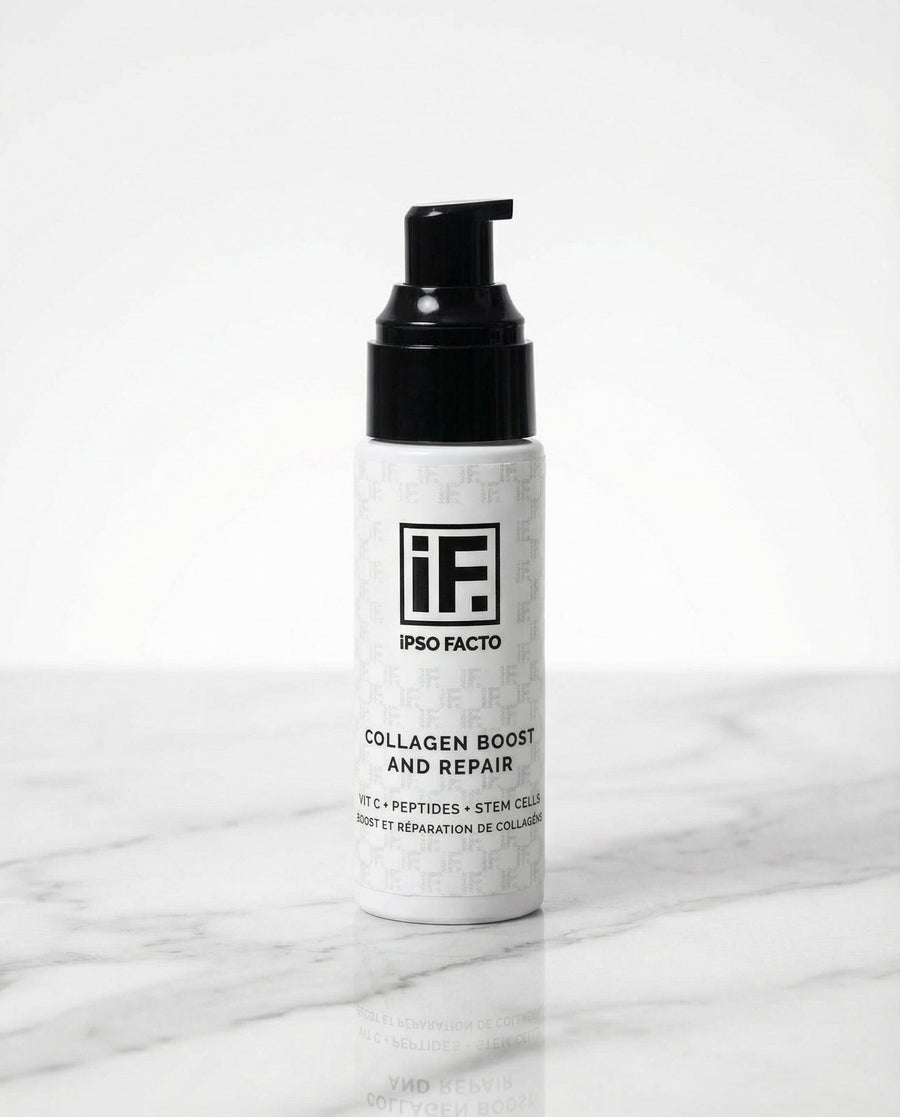
Collagen Boost & Repair
Applied & instructive
- Peptides applied directly to the skin
- Penetrate to reach fibroblast cells
- Signal those cells to produce collagen
- Vitamin C + stem cells support the process
Mechanism-based. Targets the skin and tells it what to do.
It's the difference between hoping and instructing. One scatters raw material and prays some ends up in the right place. The other goes straight to the source and presses the button.